Audit-proof archiving for SAP
Archiving is two jobs in one: keeping records in a legally compliant way – and relieving the productive database. Both only pay off once protocol, storage location and retention rules fit together.
Three decisions that make the difference
Almost every archiving initiative comes down to the same three questions. First the protocol: is classic ArchiveLink enough, or should filing run through the open OASIS standard CMIS, which is also available to non-SAP applications? Second the storage location: Microsoft Azure Blob Storage, AWS S3, Microsoft SharePoint Online or the sovereign EU cloud STACKIT. Third the rules: retention periods, immutability, legal hold and a deletion concept that stands up to an audit.
We deliberately advise on these questions vendor-independently. Separating the connection from the storage location is not a detail but the heart of the matter: decouple the two and you can change the storage later without touching the SAP side – avoiding exactly the lock-in that makes classic ECM systems so expensive.
Beyond documents it is almost always about transactional data as well. Completed documents can be moved out via SAP data archiving (transaction SARA) into ADK files and stored audit-proof. That shrinks the database noticeably – and with HANA and cloud operation it cuts running cost directly. For users, access continues unchanged from within SAP.
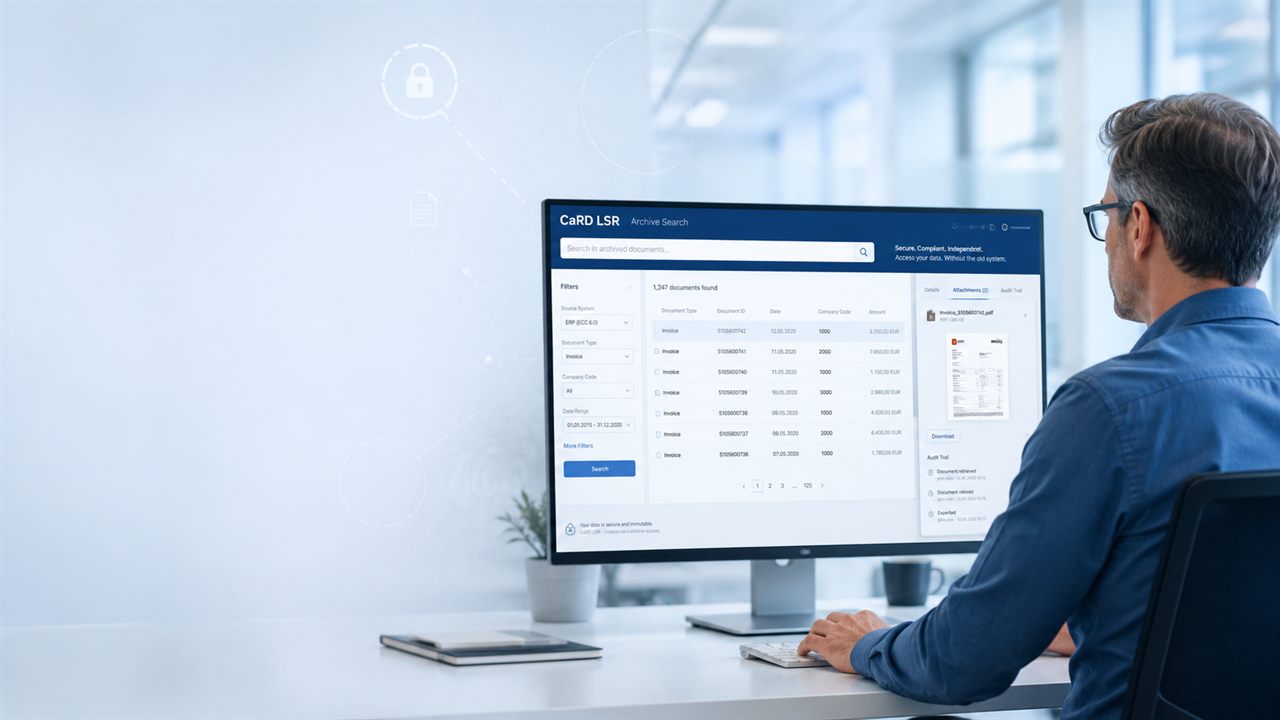
An archive is only as good as your ability to find things in it — which is exactly where we add AI as an option on top. Incoming documents can be tagged and classified automatically, so metadata exists where previously there was only a file. On the retrieval side you gain natural-language, semantic search: you describe what you are looking for instead of knowing the exact field value — including "find similar documents". In processing this extends to summaries and the detection of duplicates and anomalies across large inventories. The know-how comes from our own development, not from a bought-in component.
Two points matter to us here. First, AI is an addition, not a prerequisite. Classic rule-based search across metadata, CMISQL and full text remains fully intact — if you do not need it, you simply do not switch the AI on. Second, archive content is sensitive. Operation is therefore possible on-premise or in a sovereign EU cloud, and what a model gets to see at all is defined with you up front. Automatically assigned keywords are a reviewable suggestion, not established truth.
For implementation we use our CaRD Connector, an SAP-certified product that speaks ArchiveLink and CMIS 1.1 and serves the storage backends named above. You will find the product detail at cloudconnector-online.com; if Azure Blob Storage is your focus, blob-connector.com goes deeper. This page is about the consulting questions that come first.
At a glance
- ArchiveLink or CMIS – chosen with reasons
- One connector for every backend – switching is configuration
- Four backends: Azure Blob, SharePoint, AWS S3, STACKIT
- ECC, on-premise S/4HANA, RISE, private & public cloud
- Open to any system that speaks CMIS – SAP not required
- Optional AI: tagging, classification & semantic search
- Designed for compliance: immutable, legal hold, audit trail
- Connection and storage decoupled – no lock-in
- Transactional data archiving (SARA/ADK)
- Replacement of expensive ECM/DMS systems
Protocol: ArchiveLink or CMIS
Both routes are valid – they differ in openness and reach.
- ArchiveLink: the proven SAP standard, a drop-in for existing scenarios
- CMIS 1.1 (OASIS): open, usable by non-SAP applications too
- Inbound and outbound documents, print lists, GOS attachments
- SAP DMS, document info records and PLM originals
One connector, every backend
The same connector serves each of the four storage targets — switching is configuration, not a new project.
- Microsoft Azure Blob Storage
- Microsoft SharePoint Online
- AWS S3 and S3-compatible storage
- STACKIT as a sovereign EU cloud
- Several repositories in one installation, different backends included
- Operated on-premise or in the cloud, as you prefer
Any system that speaks CMIS
CMIS is an open OASIS standard — so the connection is not limited to SAP.
- SAP in every deployment model: ECC, on-premise S/4HANA, RISE, private & public cloud
- SAP BTP Document Management Service ("bring your own repository")
- Any CMIS client: Apache Chemistry/OpenCMIS, ECM and DMS systems
- Custom applications with no SAP involvement at all
- CMIS 1.1 Browser Binding (JSON, REST)
- SAP-certified for document management integration
Audit-proof storage
What an audit expects – and how it is implemented technically.
- Immutable storage (WORM, immutable blobs, object lock)
- Defined retention periods
- Legal hold for ongoing proceedings
- Complete audit trail
- Documented deletion concept once retention expires
Slimming the database
The lever that cuts running cost most directly.
- Data archiving via transaction SARA
- Offloading into ADK files
- Extracting binary data from database tables
- Smaller HANA instance, faster system copies
- Access for users unchanged from within SAP
AI connectivity (optional)
Tag, classify, find and process — as an addition to classic search, not a replacement.
- Automatic tagging on filing
- Classification by document type and business object
- Natural-language, semantic search across the inventory
- "Find similar documents" instead of exact field values
- Summaries, duplicate and anomaly detection
- Operation on-premise or in a sovereign EU cloud
- Opt-in: classic search via CMISQL, full text and metadata stays
Replacing legacy archives
When the existing ECM/DMS costs more than it delivers.
- Analysis of licence and operating cost
- Migration of the inventory without downtime
- Replacing proprietary interfaces
- Also for legacy archives of other vendors
Where archiving also helps
The topics that come up in the same breath.
- Before an S/4HANA migration: less data, shorter project
- When retiring legacy systems
- In scanning and document capture
- For outbound documents and e-invoicing
Frequently asked questions
ArchiveLink or CMIS – what do you recommend?
If only SAP archives and the existing landscape should stay untouched, ArchiveLink is the most direct route: it replaces the content server without changing your SAP processes. If non-SAP applications should reach the same archive, or if you want to keep interface freedom, CMIS is the better choice. The decision can differ per repository.
Is cloud storage audit-proof?
It can be — provided it is configured correctly. Azure immutable blobs, AWS S3 Object Lock and SharePoint retention policies deliver the immutable storage; combined with defined retention periods, legal hold and an audit trail, that forms the technical basis for compliant record keeping. The final assessment always also depends on your own procedures and process documentation — we bring the technical side, the organisational side we agree with you.
Does our data stay under our control?
Yes. Content resides in your own storage account, your Microsoft 365 tenant or your data centre – you choose region and provider. The connector itself stores no document content.
How much database volume can realistically be saved?
That depends on document volume and history. In systems that have grown over years, the combination of document offloading and SARA data archiving regularly accounts for a substantial share of the database. We determine the potential up front from your table and document statistics, before you decide.
What does AI connectivity actually deliver in an archive?
Four things: it tags and classifies incoming documents automatically, so metadata exists where previously there was only a file. It enables natural-language search — you describe what you are looking for instead of knowing the exact field value. It finds documents similar to a given case. And it supports processing: summaries, detection of duplicates and anomalies across large inventories. We developed this ourselves and support it in operation.
Do we have to use AI?
No, and that is deliberate. The AI functions are opt-in; classic rule-based search across metadata, CMISQL and full text remains fully intact and unchanged. If you do not need it, you simply do not switch it on.
What happens to our documents in the process?
That is defined together up front. Operation is possible on-premise or in a sovereign EU cloud, and which content a model gets to see at all is part of the concept — with archive inventories that is regularly the most important point. Automatically assigned keywords are treated as a reviewable suggestion, not as established truth.
Can we change the storage later?
Yes – that is exactly why we decouple connection and storage. Moving from one backend to another is configuration plus migration of the inventory, not a new SAP project.
Does this work with RISE and the public cloud?
Yes. The connection uses the SAP standard interfaces, available in every deployment model – from ECC through on-premise S/4HANA to RISE, private and public cloud. Under RISE and in the public cloud the route runs through the SAP BTP Document Management Service, behind which the connector sits as an external CMIS repository.
Do we need a separate connector for each storage target?
No. It is the same connector for all four backends – Microsoft Azure Blob Storage, Microsoft SharePoint Online, AWS S3 (and S3-compatible storage) and STACKIT. The storage target is a matter of configuration, not product choice; one installation can serve several repositories in parallel, including different backends.
Can non-SAP systems use the archive as well?
Yes, and that is one of the main reasons for CMIS. Because it is an open OASIS standard, any CMIS-capable application can use the same repository – Apache Chemistry/OpenCMIS clients, ECM and DMS systems or your own line-of-business applications. SAP is the most common use case, but not a prerequisite.
Does this match your project?
Talk directly to our consultants — no detours.